









Antalya (Türkiye ) : Nepal, Bhutan, and Kyrgyzstan have jointly taken an initiative to put the rising crisis in mountain areas due to climate change on the priority list of international climate talks.

Nepal has stated that even though the issue of mountain regions and climate change could not be included as a separate agenda at the 31st Conference of the Parties (COP-31) of the United Nations Framework Convention on Climate Change, there has been positive progress towards including it in the decisions of upcoming talks and conferences.
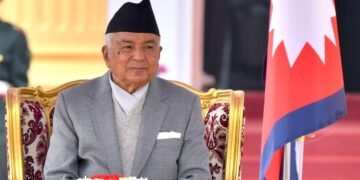
At the UN media conference held here on Tuesday, Minister for Foreign Affairs Shisir Khanal said that the challenges to the existence faced by mountain communities due to climate change need to be formally recognized.
He said that mountain communities, like small island nations at risk of rising sea levels, are also at the forefront of the climate crisis. According to him, Nepal, together with Bhutan, had proposed to include the mountain issue on the conference agenda.
After Kyrgyzstan also came up with a separate proposal, all three countries have moved forward with a joint effort.
Although the mountain issue couldn’t be included as a new agenda, Minister Khanal said that the organizers and the chair of the conference assured that they would work with the relevant country over the next two weeks to include the issue in other decisions.
He mentioned that there is a lack of sufficient data and studies on the condition of the mountainous region, glaciers, and the changes happening when snow and ice melt in the high mountain areas, as well as the impact this has on the lives of the local community.
Minister Khanal said that there is a need for a comprehensive study of the mountain region, effective policies for climate adaptation and mitigation, and separate action plans and financial resources for mountain communities.
At the programme, Dr. Rajendra Prasad Mishra, Secretary of the Ministry of Agriculture, Forests and Environment, mentioned that even though Nepal’s contribution to climate change is negligible, the country has to seriously face its impacts. He also pointed out that just last October, Nepal had to deal with three major climate-related disasters.
Nepal proposes four topics
Secretary Mishra mentioned that Nepal has proposed four topics and, by integrating them with Kyrgyzstan’s proposals, a joint mountain agenda was moved forward.
According to him, after intensive discussions, the member countries have agreed to hold a ‘research dialogue’ on mountain issues in the upcoming session.
It has been agreed to organize two more dialogues before the second global review (Global Stocktake) in 2028. Accordingly, three dialogues will be held on mountain issues.
Secretary Mishra informed that the COP presidency has agreed to consult with the group of mountainous countries on including specific indicators related to mountainous regions in financial structures, such as the operation of mountain programmes and the New Collective Quantified Goal (NCQG) on Climate Finance.
He also mentioned that in the discussions with representatives chaired by Australia and Türkiye, positive signals were received about including work based on mountain climate science, research, risk and vulnerability, early warning systems, and preparedness in the final decision. Nepal will present its stance on this matter in the upcoming meeting.
In an informal discussion, Joint Secretary of the Ministry Dr. Maheshwar Dhakal informed that China has also expressed positive support for the mountain itinerary.
He stated that Nepal believes the mountain issue should be addressed as a comprehensive package, not just limited to science, finance, or technology transfer.
According to him, the budget-related detailed discussion covered Nepal’s situation, opinions on voting, and decision-making processes. He mentioned that Nepal expressed thanks for the sympathy and solidarity shown by the fund’s board, co-chairs, members, and developed countries.
At the programme, Deepa Oli, the Under Secretary of the Ministry of Agriculture, Forests and Environment, mentioned that the sensitive mountain ecosystems, ranging from the world’s highest peaks to deep valleys, are seriously affected by climate change. She said that mountain countries even have to bear the burden of climate change that Nepal did not create.
Nepal’s key climate change priorities highlighted
At the event, members of Nepal’s high-level delegation shared their views on Nepal’s key climate change priorities, the human and economic losses from recent extreme climate-related disasters, and the support expected from the international community.
Even though Nepal’s contribution to climate change is minimal, the country has had to bear its impact significantly. Nepal has been prioritizing issues like climate justice, adaptation, and increasing international support for climate finance at COP-31.
Mountain Dialogue to be held in 2027 and 2028
Nepal and Bhutan have reached agreement on some important issues related to the mountain agenda proposal presented at COP-31.
According to the proposal, it has been agreed to hold two mountain dialogues – one in 2027 and the next one in 2028.
Dr. Maheshwar Dhakal, Joint Secretary at the Ministry of Environment and Head of the Climate Change Management Division, mentioned that Nepal and Bhutan have already agreed on some important points of the proposals they put forward together, and efforts are ongoing to include the remaining priorities in the decisions and conclusions of COP-31.
“An agreement has been reached to organize two mountain dialogues in 2027 and 2028. Efforts are ongoing to reflect the other priorities included in the proposal in the decisions of COP-31,” he said.
According to Joint Secretary Dhakal, during COP’s opening session, different parties along with the presidium had highlighted Nepal’s special situation and context with importance. He mentioned that Nepal’s views and interventions during the passing of the conference’s formal agenda also highlighted the importance of the mountain agenda on the international stage.
Nepal and Bhutan had proposed including the mountain agenda in COP’s formal agenda to address the growing impact of climate change in the Himalayan and mountainous regions. Even though there wasn’t agreement on including it as a separate agenda, efforts are being made to incorporate mountain issues into various discussions and decision-making processes.
Nepal has been calling for scientific research on the impact of rising temperatures in mountainous areas, increasing the adaptive capacity of mountain communities, easy access to climate finance, and special programmes for mountainous regions.
COP-31 is currently underway in Antalya, Türkiye from November 9. It will conclude on November 20.