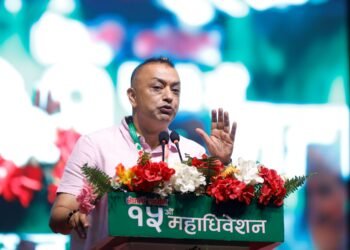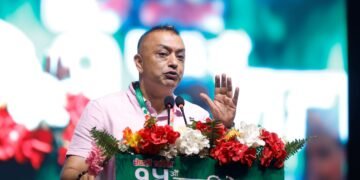
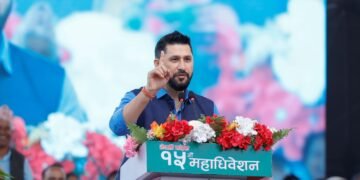
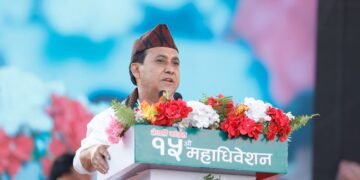
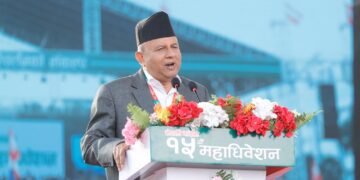
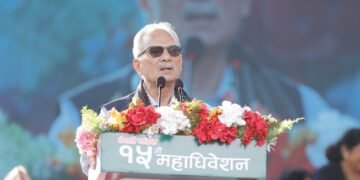




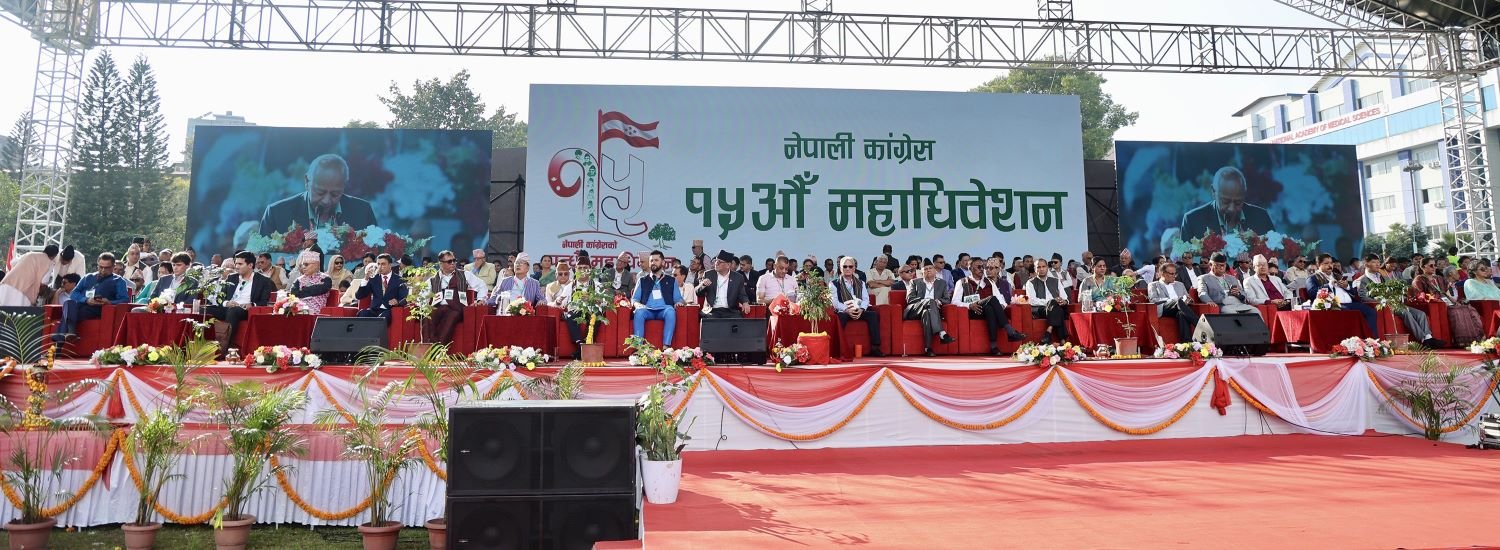
Kathmandu, Oct 4: Preparations for the 15th General Convention of the Nepali Congress have been over. The General Convention is kicking off at the local Khulamanch (open theatre) in Tundikhel in a while.

The following two days will be spent for closed sessions under the Convention, while elections slated for October 7-8. The event originally scheduled for October 2 was put off by two days following continuous rainfall across the country.
Representatives from home and outside the country continue to arrive in Kathmandu to participate in the event. Fifteen different preparations committees have been formed to facilitate the General Convention.
A grand stage is ready at an inauguration venue, Khulamanch. According to NC spokesperson Devraj Chalise, separate mega halls have also been set up at Khulamanch to run the closed sessions.
The venue also features a media centre and a primary health care unit.
The Accommodation Management Committee has designated a coordinator for each electoral constituency, district, and province to manage lodging arrangements for the General Convention participants from those respective areas.
Accommodation facilities have been managed in the Tribhuvan International Airport area, Gaushala, Sundhara, Thamel, Lazimpat, Kalanki and New Bus Park. Information about it has been circulated to participants via WhatsApp messages, AI numbers and SMS.
According to the committee, breakfast, lunch and dinner have been available at Bhrikutimandap area. The General Convention central election commission informed RSS that around 7,500 representatives are attending the event. This is the first time in the party that such a largest number of representatives have been elected for the General Convention.
Both the inaugural and closed sessions are scheduled to be held in Khulamanch.
The party president, vice-president, general secretary and treasurer will present separate reports in the national gathering.
Three separate panels will be formed on the basis of geographical cluster to discuss such reports. Each participant in the hall will have access to report via a digital board, according to spokesperson Chalise. Three halls named Himal, Pahad, and the Terai-Madhesh are fixed for organising the closed sessions.
Leaders from various political parties are invited to the inaugural session. The invitees are Rastriya Swatantra Party’s president Rabi Lamichhane, CPN (UML) chairman KP Sharma Oli, CPN (Maoist Centre) coordinator Pushpa Kamal Dahal ‘Prachanda’, Rastriya Prajatantra Party chairman Rajendra Lingden, Janata Samajbadi Party chairman Upendra Yadav, Janamat Party chairman Chandra Kanta Raut, Shram Sanskriti Party general secretary Aaren Rai, and acting general secretary of Rastriya Janamorcha, Ghanshyam Paudel.
Socialist International’s general coordinator Chantal Kambiwa is among international guests invited to the inaugural session. She has been in Kathmandu to attend the event.
The 15th General Convention of Nepali Congress is taking place in Tundikhel from where party founder and first people’s elected Prime Minister BP Koirala delivered his first public address following his return from exile.
Tundikhel also holds significance in the history of Nepal’s democratic movement. It was here that another founding leader of the Nepali Congress, Ganeshman Singh, proclaimed the success of the 1990 People’s Movement which had brought an end to the then autocratic Panchayat rule.
Party President Gagan Kumar Thapa will inaugurate the General Convention which will be addressed by top party leaders well as key leaders from other major political parties in the country.
According to Chalise, this is a historic General Convention in a sense that 44,000 youths of the new generation have assumed responsibilities and above 7,000 representatives selected in participations of them are attending it.
The event is being held following the NC’s second Special General Convention that was organised on January 12-17 in Bhrikutimandap.
Bearing in mind the significant loss of lives and property caused by the August 26 flood disaster, the party has decided to organise the General Convention in a simple manner, refraining from the extravagance in its publicity.
Besides this, information and messages about the General Convention have been circulated through around 100 digital boards in various major cities in the country including the Kathmandu Valley.
Candidates contesting the elections to be held under the General Convention have been directed to utilize only digital platforms for campaigning. Furthermore, the party has implemented a policy promoting eco-friendly campaign practices.
“Placing, pasting, or distributing flex boards, banners, posters, pamphlets, or any other type of printed promotional material at the convention venue or in the surrounding areas is strictly prohibited,” said Raju Katuwal, the Committee’s Member-Secretary.
According to the Election Committee, the registration of nomination papers for candidates will take place at the National City Hall (Rastriya Sabha Griha) in between 2:00 PM and 6:00 PM on Monday, October 5.
Under the new provisions, the Congress central working committee will have 232 members. Of these, 171 members will be elected, while 61 will be nominated by the president. The number of joint general secretaries has also been increased from eight to eleven. The new provisions further allow members to be elected from inclusive groups, while some positions will be filled through the nomination by the president.
Parking lots at eight locations
The Transport Management Committee under the General Convention informed that parking lots for the vehicles were managed at eight different locations to facilitate the participants and delegates coming to the convention venue.
The parking lots for delegates are the underground parking of Dharahara, premises of Salt Trading next to Baggikhana, the old bus park area, the one-lane road outside Bhrikutimandap, premises of the National City Hall, the Nepal Academy, and the Annapurna Hotel at Durbar Marg, according to the Committee coordinator Bijay Bahadur Swar.
“Coordination has been established with the Traffic Police and the District Police Range, Kathmandu for managing parking on roadside between Maitighar Mandala and Bhadrakali for passenger buses ferrying delegates to the convention from outside the Kathmandu Valley,” said coordinator Swar. However, parking at the Dharahara underground and the Annapurna Hotel parking lot would be charged, while parking will be free in other spaces.
Health desk for emergency service
A health desk with 30 health workers has been established at the General Convention. Necessary health services will be provided to the delegates through the health desk.
According to Dr Kedar Narsingh KC, coordinator of the Health Committee, a ‘health desk’ was installed at the western side of the Khulamanch where the general convention is located. General health check-ups and emergency services will be provided through the health desks with five stalls.
From youths to lateral entry
One of the significant features making this General Convention unique is the representation of youths under 35 in the party’s leadership layer. The statute has made arrangements to increase the participation of youth from the ward to the centre.
Similarly, 21 youth members under 35 will be elected to the Central Working Committee. Youth representation has been ensured from provincial and open groups to the central leadership.
At least one-third of women’s representation is ensured in the working committees of various layers of NC. It is for increasing women’s participation from the ward to the centre.
People who have acquired expertise in various professions, businesses and fields will also be allowed in the party leadership positions.
Six central members will be elected from among the general convention delegates come from the Nepali Public Relations Committee. It creates a formal channel to the NC-affiliated Nepalis living abroad in the central structure.
People living with disabilities, minorities and those from backward areas will also be in the central committee. Representation of the workers and democracy fighters, families of martyrs and conflict victims is another feature.
Although preparation was made to adopt electronic voting, technical and managerial aspects hindered it this time.
In addition to election of new leadership by the General Convention, debates on the party’s political direction, organizational reforms and the role of the new generation are essential topics in agenda.