







Kathmandu, Jan 21: Chief of Army Staff (CoAS) Ashok Raj Sigdel has said that current international and regional security situation has turned to be multi-dimensional, complex and challenging.
He noted that national security is increasingly challenged due to the weak and interest-centered alliances of multilateral institutions, extensive use and misuse of information technology, and the declining decision-making capacity of small nations.

At the seminar ‘The Role of the Defence University in Nepal’s National Security, National Unity and Prosperity’ organized by the Infrastructure Development Committee of the National Defence University, Nepal Army Chief Sigdel stressed the need for a shared understanding and perception among stakeholders in the scope, dimensions and practice of national security.
‘Nepal’s geopolitical position, fluid political situation, activities of various groups and organizations, migration, dependence on foreign employment, declining agriculture and increasing imports are creating additional complexities in economic and social security’, Chief Sigdel argued.
He highlighted the need of a thorough analysis of the potential impacts on national and internal security in the complex and multidimensional social environment, along with short-term, medium-term and long-term strategic perspectives, is now indispensable for effective national security management.
Chief of Army Staff Sigdel stated that the primary objective of national security is to safeguard national interests through the coordinated use and application of state power.
“In the current global context, national security and defense are not limited to traditional military security alone but are linked to social stability, good governance, economic prosperity, strong diplomacy, effective information systems, use of technology, and all matters related to national interest. ”
Emphasizing the need to strengthen national security while maintaining traditional relations, mutual tolerance, and unity in a multicultural society, NA Chief Sigdel said,
“By basing national security on a coherent policy, all relevant agencies in Nepal can be made strong, capable, and resilient, and during times of internal and external security challenges, security can be strengthened by identifying and analyzing threats, and harmonizing defense, internal security, public safety, foreign affairs, and economic policies.”
Also speaking on the occasion, Executive Director of the University Infrastructure Development Committee, major general Bishnu Raut informed that the curriculum development work of the university, which is advancing as a major academic research institution in Nepal, has reached its final stage.
Dr. Shambhuram Singhada, a member of the university’s academic group, stated that while society progresses through discussion and debate, everyone needs to recognize that the security forces are organizations that operate with a definite structure, discipline, and order.
Foreign affairs expert Dr. Nishchal Nath Pandey expressed the view that the executive, legislative, and judiciary were weakened during the Gen-Z movement,. “Nepal Army’s experience, capability, strategic knowledge, and prudent actions led to the formation of a new government and the creation of an electoral environment in the country.” he claimed.
Conflict management expert Dr. Pitambar Bhandari emphasized that the Defense University, which conducts research and gains knowledge on sensitive subjects like national security, should have its own budget and investment.
Academic subcommittee member Prof. Dr. Mina Devi Baidya shared her views on the university’s role in developing strategic leadership and formulating national security strategies.
Defense University project chief Binaya Rana expressed the opinion that Nepal’s proud history should be connected with modernity.
Academic subcommittee member and former lieutenant provided information about the structure of 15 subjects to be covered over three semesters.
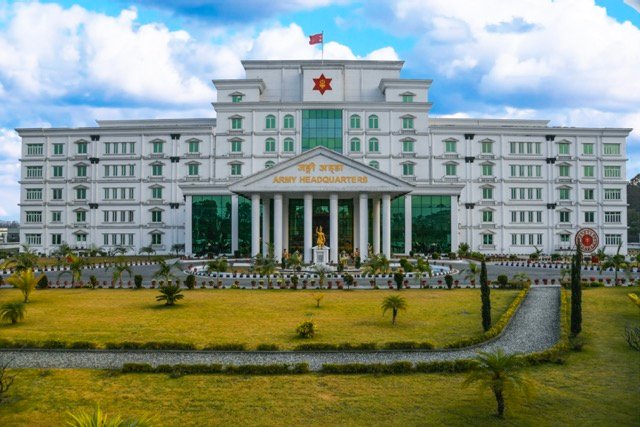
The university, being constructed in Kavre Banepa Municipality–13 and 14 at a cost of Rs 8.63 billion, is in the process of developing curriculum with the aim to commence operations from coming July.