





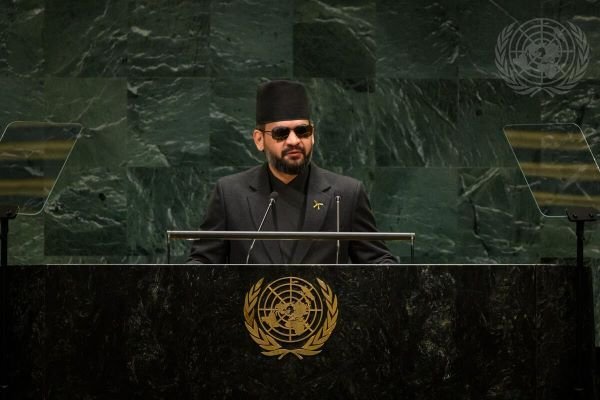
Kathmandu, Sept 25: Prime Minister Balendra Shah made his first appearance on the world’s premier diplomatic stage on Thursday, bringing to the 81st Session of the United Nations General Assembly a stark account of Nepal’s devastating climate-induced disaster and a call for greater global solidarity, climate justice and a fairer international order.

Shah’s first trip to New York for the UN General Assembly was also marked by a low-key approach. He left Kathmandu without the kind of fanfare and large entourage that have often accompanied such high-level visits in the past. His delegation was kept small, with his spouse also not included in the official delegation.
The relatively lean delegation and restrained arrangements reflected a different approach to a major international engagement, with the Prime Minister travelling primarily for the UNGA and high-level diplomatic meetings rather than around a large official entourage.
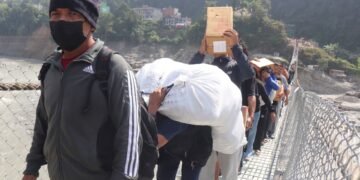
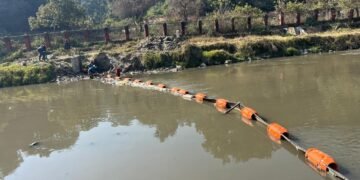
Addressing the General Assembly in New York, Shah spoke of the devastation caused by the recent Bhotekoshi-Trishuli floods and landslides, saying families were still waiting for loved ones, communities were searching through debris, and bridges, roads, schools, homes and livelihoods had been swept away.
But his message went beyond Nepal’s immediate tragedy. He presented the disaster as a warning about the growing risks faced by Himalayan countries and other vulnerable nations that have contributed little to the climate crisis.
Nepal contributes less than 0.1 percent of global greenhouse-gas emissions, Shah said, yet it is paying a heavy price for a crisis it did little to create. Climate change, he argued, is no longer simply an environmental or humanitarian issue for Nepal; it has become a development challenge capable of wiping out years of progress.
“The climate crisis does not recognise borders,” he said, pointing to the increasingly fragile Himalayan environment, where melting permafrost, unstable mountain slopes, glacial hazards, floods and landslides are creating complex and growing risks.
This was the central message of Shah’s address: countries that are most vulnerable to climate change need climate justice, adequate resources and practical international support.
He called for global climate action to be guided by the principle of common but differentiated responsibilities and respective capabilities, arguing that countries with greater historical responsibility for emissions and greater capacity should do more.
Shah also urged the international community to provide adequate grant-based assistance for Nepal’s recovery and reconstruction. He said existing climate finance arrangements, including the Loss and Damage Fund, remain inadequate, while vulnerable countries often face lengthy procedures before receiving support after disasters.
“When the house is burning, we do not ask the family to complete fifty forms. We act,” he said.
The Prime Minister also proposed a Himalayan Climate Resilience Mechanism involving Nepal, India and China. Such a mechanism, he said, could promote the sharing of satellite data and technical expertise, monitoring of dangerous glacial lakes, stronger early-warning systems and coordination of assistance during disasters.
Shah stressed the importance of the Hindu Kush Himalaya, saying the region is home to nearly two billion people and provides water, ecosystems, agriculture and livelihoods to communities across Asia.
“The Himalayas are not peripheral to the planet. They are part of the planet’s life-support system,” he said.
While seeking greater international support, Shah also highlighted Nepal’s own efforts to address climate change, including forest restoration, hydropower development, promotion of electric mobility and strengthening climate adaptation at the local level.
His speech then broadened from climate change to wider inequalities in the international system.
Shah questioned how the world can move military hardware and ammunition across borders efficiently while farmers in poorer countries can struggle to obtain fertiliser and fuel.
“We have built a world with flawless logistics for war and broken logistics for food,” he said.
He called for a more equitable international economic order and reaffirmed Nepal’s commitment to multilateralism. Small, landlocked, least-developed and vulnerable countries, he said, must have a meaningful voice in global decision-making.
Shah also linked Nepal’s international message with the aspirations of its young people. He said Nepali youth had demanded greater integrity and accountability in politics and that his government was committed to creating decent employment, social protection and opportunities for people to build their future at home.
He urged the international community to move beyond ad-hoc disaster response and invest more in preparedness, resilient infrastructure, insurance, innovation and early-warning systems to cope with increasingly frequent and intense climate-related disasters.
The closing moments of Shah’s address, however, brought a message deeply rooted in Nepal’s own identity.
After delivering his main remarks in English, Shah switched to Nepali for his closing words. He invoked Lord Pashupatinath while wishing for the wellbeing of the world and referred to Gautama Buddha and his teachings of peace and compassion.
His final message was that humanity should follow the path of peace.
He concluded with “Thank you” and “Namaste”.
The closing gave Shah’s first UNGA address a distinctly Nepali voice. After speaking about climate disasters, inequality, conflict and the shortcomings of the global system, he ended by drawing on Nepal’s spiritual heritage and its association with the message of peace.
Shah’s first appearance at the General Assembly thus carried Nepal’s appeal for climate justice to the world stage while also presenting the country as a partner in regional cooperation, climate resilience, multilateralism and the broader pursuit of peace.